Can Dogs Eat Cream Cheese? Types, Portions & Pills (2026)
Last updated: November 25, 2026 · Sources are listed at the bottom. How we research
Veterinary reviewed by Dr Zahid Iqbal, DVM, MRCVS and Dr Fatih Bozbay, Veterinarian.
Cream cheese is spread on bagels and used in dips, and it is also a popular way to hide a pill, so many dogs know it well. Most healthy dogs can have a tiny amount of plain cream cheese now and then. It is not toxic, but it is very rich, with about a third of it fat.
Below you will find which cream cheese is safe and which is not, how much a dog can have and whether it is a good way to hide a pill.
Quick answer: Yes, most healthy dogs can have a tiny amount of plain cream cheese now and then. It is not toxic, but it is very rich: about one third of it is fat. Keep it to a pea-sized dab for a small dog and no more than a teaspoon for a large one, never give garlic, onion, chive, herb or sweetened versions, and skip it if your dog has had pancreatitis, is overweight or reacts to dairy.
- OK in tiny amounts: plain cream cheese, plain low-fat or whipped cream cheese
- Never: garlic and herb, chive and onion, vegetable, jalapeno or smoked salmon cream cheese
- Never: sweetened, flavored or sugar-free spreads, and cream cheese frosting or cheesecake
- Avoid: bagels, crackers and toast, and any foil wrapper
Jump to: Which kind · How much · Hiding pills · Who should skip it · Ate too much · FAQ
Is cream cheese safe for dogs?
Plain cream cheese is not a recognized toxin for dogs, and a small amount is fine for most healthy adults. The concerns are calories, fat and lactose. The USDA lists cream cheese at about 350 kcal and 34 g of fat per 100 g, and one tablespoon (about 14.5 g) is roughly 51 kcal. That is more than four times the calories of the same weight of low-fat cottage cheese, which has about 81 kcal per 100 g.
Fat. Rich, fatty snacks are linked to pancreatitis in dogs that are prone to it. One serving of cream cheese does not diagnose or predict pancreatitis by itself, but it is a good reason to keep portions tiny.
Lactose. Like other dairy, cream cheese contains lactose. Many adult dogs digest dairy poorly, so gas, bloating or loose stools within a day mean it is not agreeing with your dog. Stop if that happens.
Weight. A teaspoon is about 17 kcal, which is a big share of the day for a toy breed. Small daily servings can quietly add pounds.
Which cream cheese is safe, and which is not?
The flavor matters far more than the brand. Read the ingredient list before you offer a lick, because the dangerous ingredients hide in the flavored tubs.
Our calorie ceiling is much higher than those servings, and that is on purpose. We worked it out the same way as in our cheese guide: all treats stay under 10% of daily calories, estimated as 1.6 × resting energy requirement (70 × body weight in kg to the power 0.75), divided by about 3.5 kcal per gram of cream cheese. It shows the absolute limit if cream cheese were the only treat, but fat makes cream cheese a food to keep far below that limit.
Use the smaller serving, not the ceiling. Offer a tiny lick the first time and watch your dog for a day. Active, underweight or overweight dogs need different numbers, so ask your vet.
| Type | Verdict | What to know |
|---|---|---|
| Plain cream cheese (block or tub) | Tiny amounts | About 350 kcal and 34 g fat per 100 g. Use only the smallest amount. |
| Plain low-fat | Tiny amounts | About 200 kcal per 100 g, and still sticky enough for pills and lick mats. |
| Plain fat-free | Tiny amounts | About 105 kcal per 100 g. Check the label for extra ingredients. |
| Plain whipped | Tiny amounts | Same portions as regular. Check the label. |
| Garlic and herb, chive and onion, vegetable | Never | Onion, garlic and chives can damage a dog’s red blood cells. |
| Jalapeno or smoked salmon | Never | Spice and seasoning that dogs should not have. |
| Sweetened, fruit or sugar-free | Never | Added sugar, and some sugar-free products contain xylitol, which is highly toxic to dogs. |
| Cream cheese frosting, cheesecake | Never | Sugar and fat, and sometimes xylitol or raisins. |
| On a bagel, cracker or toast | Avoid | The bread adds calories, and flavors such as onion, garlic or raisin add risk. |
How much cream cheese can a dog have?
Less is better here. A vet-reviewed guide suggests the following for an occasional treat. Treat it as a maximum for a healthy dog, not a daily habit.
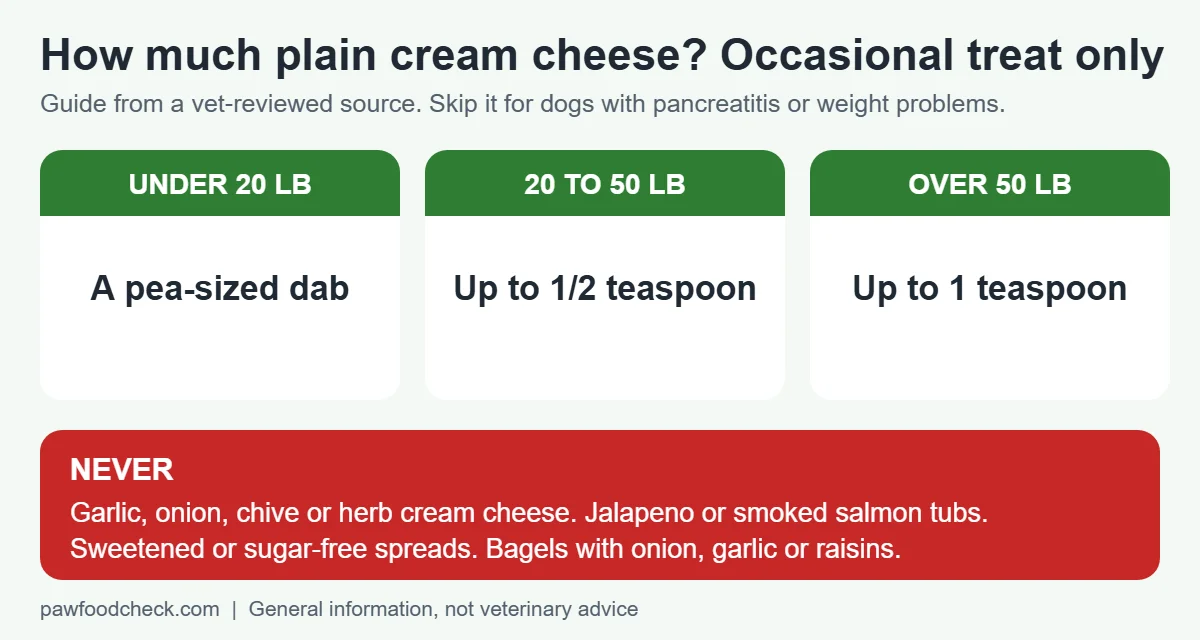
| Dog size | Occasional plain cream cheese |
|---|---|
| Small (under 20 lb) | A pea-sized dab |
| Medium (20 to 50 lb) | Up to about 1/2 teaspoon |
| Large (over 50 lb) | Up to about 1 teaspoon |
| Any dog with weight or pancreas problems | Skip it, or ask your vet first |
| Dog weight | Treat budget (10%) | Calorie ceiling of plain cream cheese |
|---|---|---|
| 5 lb (2.3 kg) | ~21 kcal | 5 g (about 1 tsp) |
| 10 lb (4.5 kg) | ~35 kcal | 9 g (about 2 tsp) |
| 20 lb (9.1 kg) | ~59 kcal | 16 g (about 3 tsp) |
| 35 lb (15.9 kg) | ~89 kcal | 25 g (about 5 tsp) |
| 50 lb (22.7 kg) | ~116 kcal | 33 g (about 7 tsp) |
| 75 lb (34 kg) | ~158 kcal | 45 g (about 9 tsp) |
| 100 lb (45 kg) | ~196 kcal | 55 g (about 11 tsp) |
Can you hide a pill in cream cheese?
Many owners do, and it can work, but check first. Confirm with your vet, the pharmacist or the medicine label that the tablet can be given with food or dairy, because some medicines need an empty stomach and the calcium in dairy can affect how others are absorbed. Use only the smallest amount needed, make sure your dog swallowed the whole dose, and do not rely on it for a dog with pancreatitis or a low-fat diet. A small piece of plain cooked chicken or a pill pocket are alternatives.
Which dogs should skip cream cheese
- Dogs with a history of pancreatitis, gut disease or obesity.
- Dogs on a prescription or low-fat diet. Do not add treats unless your vet says so.
- Dogs with a known dairy intolerance or allergy. Itchy skin, ear problems or stomach upset after dairy are reasons to avoid it.
- Dogs whose medicine label forbids food or dairy.
- Puppies. A rare, very small taste of plain cream cheese at most.
My dog ate cream cheese. What now?
A larger amount of plain cream cheese. Expect possible gas, vomiting or diarrhea. Offer water and skip other rich food. Call your vet if vomiting repeats, if your dog has a hunched or painful posture, seems very tired or refuses food. These can be signs of pancreatitis, so do not wait for it to get worse.
A flavored tub with garlic, onion, chive or herbs, or a sugar-free one. Call your vet or a poison line straight away. In the US: ASPCA Animal Poison Control Center (888) 426-4435 or Pet Poison Helpline (855) 764-7661 (a consultation fee may apply). Keep the tub so you can give the exact ingredients, and have your dog’s weight, the amount and the time ready.
Foil wrapper. If your dog swallowed the foil from a block, call your vet, because it can cause a blockage.
Safer alternatives
Plain low-fat cottage cheese is a lower-calorie choice in small amounts (see Can Dogs Eat Cottage Cheese?), and plain cooked chicken or a dog-safe treat works for pills and lick mats. For how cream cheese compares with the other cheeses, read Can Dogs Eat Cheese? or browse our Dairy section.
Frequently asked questions
Can dogs eat cream cheese every day?
It is not recommended. It is rich, and daily servings add fat and calories. Keep it occasional and tiny.
Is cream cheese toxic to dogs?
Plain cream cheese is not toxic. Flavored versions with garlic, onion or chives can be, and sugar-free ones may contain xylitol.
Can dogs eat Philadelphia cream cheese?
Plain varieties of any brand follow the same rules: tiny amounts only. Skip every flavored version, and check the label of sweetened or sugar-free tubs.
Can dogs eat low-fat or whipped cream cheese?
Yes, plain ones, in the same tiny portions. Low-fat versions cut some calories but are still rich.
Can dogs eat cream cheese on a bagel?
It is better not to. The bread adds calories, and onion, garlic or raisin bagels add risk.
Can puppies eat cream cheese?
Only a rare, very small taste of the plain kind, and ask your vet first.
Can dogs eat cream cheese frosting or cheesecake?
No. They are high in sugar and fat, and some contain xylitol or raisins.
Is cream cheese or cottage cheese better for dogs?
Plain low-fat cottage cheese has far fewer calories and less fat per spoon, so it is the better choice. Either is a small occasional treat.
The bottom line
A tiny dab of plain cream cheese is an acceptable occasional treat for most healthy dogs. Keep it plain, keep it small, check the label for garlic, onion, chives and sweeteners, and ask your vet first if your dog has pancreatitis, weight problems, a dairy intolerance or a prescription diet.
This article is general information and does not replace advice from your own veterinarian. I am not a veterinarian. See our disclaimer.
Related guides
- Can dogs eat ice cream?
- Can dogs eat sliced cheese?
- Can dogs eat cheese curds, Manchego & specialty cheeses?
- Can dogs eat yogurt?
- Can dogs eat sour cream?
- Can dogs eat bagels?
- Can dogs eat cake?
References
- WebVet: Can Dogs Eat Cream Cheese? (verdict, serving sizes, flavors to avoid, pill and pancreatitis cautions, foil)
- Cuteness: Can Dogs Have Cream Cheese? (not toxic, lactose, pancreatitis)
- The Honest Kitchen: Tips and tricks for pilling your dog (higher-fat foods and pancreatitis)
- USDA FoodData Central: cream cheese (FDC ID 173418), low fat (169079) and fat free (172207); cottage cheese 2% (172182)